
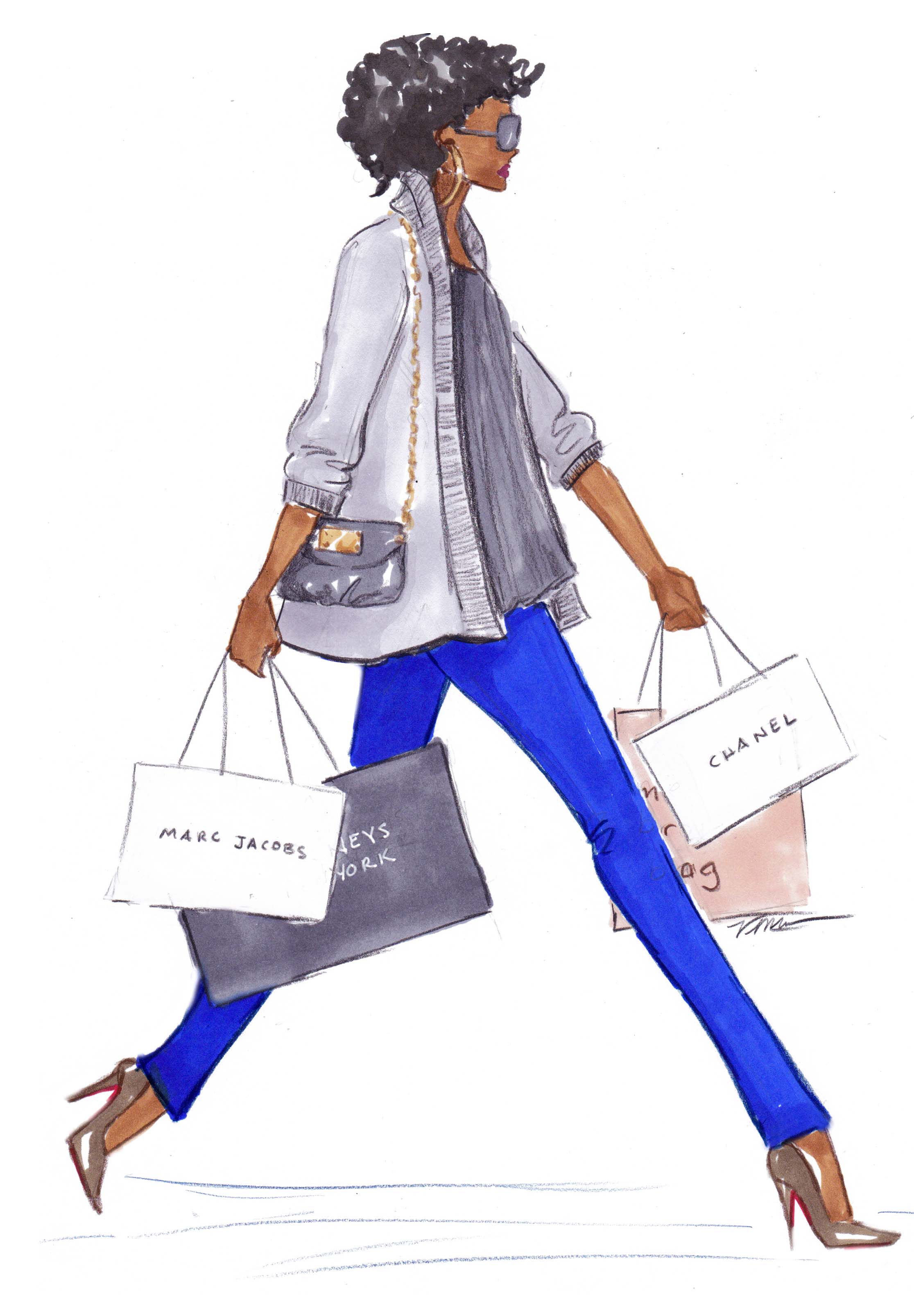
Illustration by Veronica Miller.
It’s no secret that black women love fashion. Some of us grew up snuggling copies of Vogue or Glamour, trying to recreate model poses in front of the mirror. For others, the ladies at church set the example, with their majestic hats and incredible stiletto pumps stomping around the pews. And for a few more, we grew up with a cadre of mommies, aunties and grandmothers who passed down and passed around fur coats, silk scarves, designer bags and heirloom jewels.
Suffice it say, a black girl’s love affair with fashion is just as fervent as any other woman’s. But it comes with an unsettling awareness — as much as we may love those Vuitton handbags, those Chanel jackets, those Burberry coats, the folks that sell them to us insist on pretending we don’t exist.
Look at the runways — no, rather look at the fact that Jezebel has to keep an eye on the runway and call out the fact that the number of black women (and any other women of color) walking the catwalk is woefully low. Look at the fact that fashion brands become nervous when the “urban” (read: black) crowd becomes fond of them. Look at the fact that Prada’s use of black model in their fall ’13 campaign was hailed as some sort of ground-breaking accomplishment — when really, it was the first brown face that Prada employed in their ads in almost 20 years. That’s not really anything to be terribly proud of.
All of this is why I’m glad Fashionista.com ran an article asking the fashion industry, “What’s the effing deal, guys?” Jihan Forbes points out that black Americans spend an incredible amount of money on designer fashion — perhaps an alarming amount. But for all the free press that designers get when a popular black celebrity starts rocking their wares, fashion seems on insistent on acting like black high-end customers don’t exist. Forbes writes:
According to the Nielsen report, 73% of whites feel that blacks influence mainstream culture, even though they make up a much smaller segment of the population. But if black folks are determining what’s cool, why are brands so hesitant to add black faces in their ads, or even to their fashion shows?
Forbes follows with an unsettling list of reasons, from the tired “aesthetics” excuse for runway racism (“Black models would distract from the clothes!”) to the fear that attracting black customers means that a brand will alienate its “core” (read: white) customer base. (Or, more bluntly, the fear of bigoted customers taking their dollars elsewhere.)
At the same time, black consumers have the power to speak more with their dollar. Says one observer, “Why would a company spend money advertising to people who are going blindly buy their stuff anyway?” Because of the name recognition, high-end fashion companies don’t need to “convince” black customers to come into their stores or shop their web sites. So there’s no incentive to spending more money on targeted advertising.
Now, as a black women who love fashion, we’re thinking harder about who we’re giving our dollars too. It sucks that even shopping has to be a political act, but that’s how the world works when you’re an underrepresented minority. Luckily, there are a number of influencers, including Bethann Hardison and super-mogul Iman, who are spearheading the call for change. And there are a number of designers — Marc Jacobs, Tom Ford, Tracy Reese and Catherine Malandrino among them — who gladly embrace diversity with open arms.
So for now, while fashion figures out its diversity problem, maybe its best for black fashion lovers simply to follow the old adage — Go (and spend your money) where you’re wanted.

 )


